MARRAKECH -WHAT I FOUND THERE
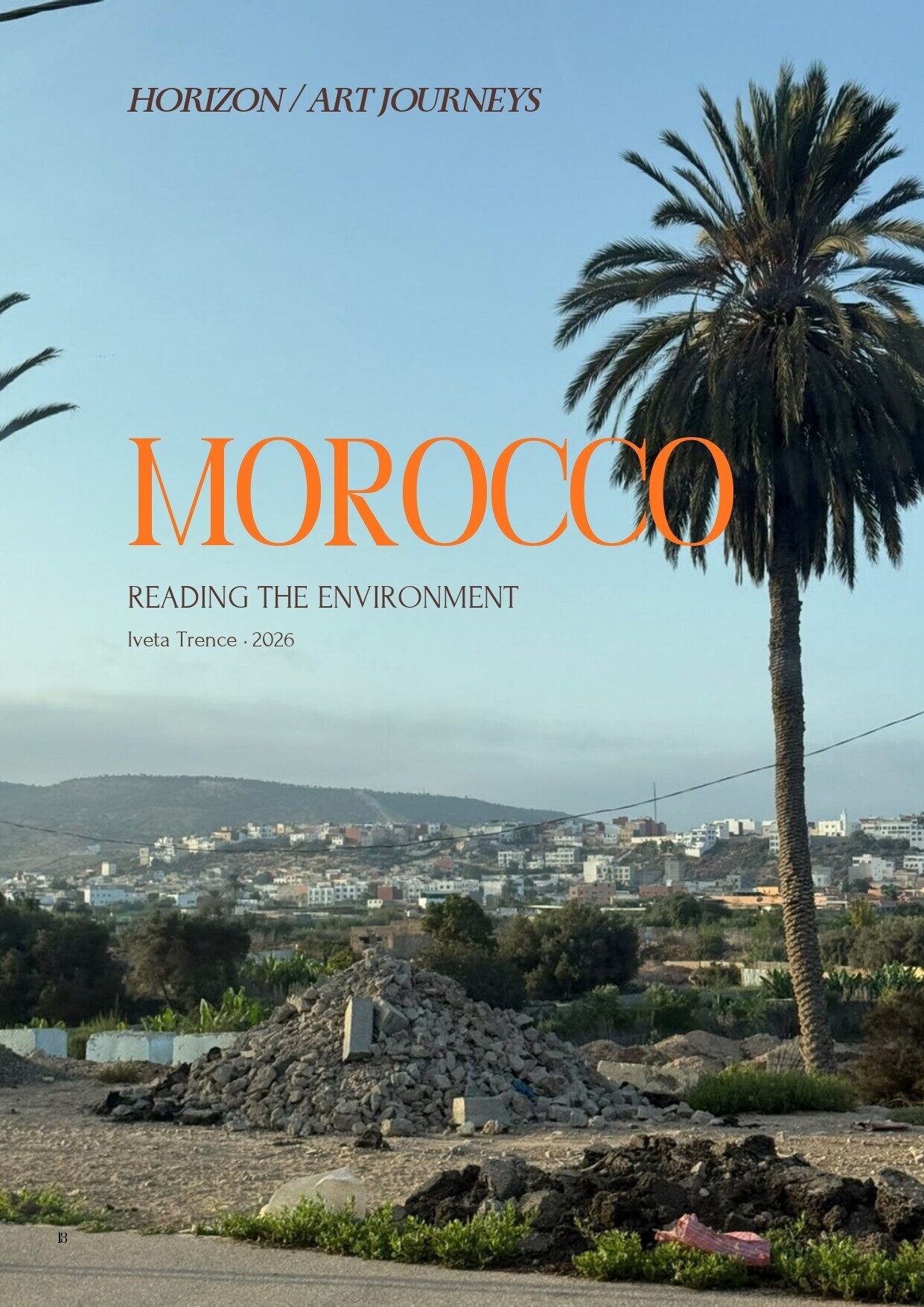
AN ATTEMPT TO UNDERSTAND MORE PRECISELY THE RELATIONSHIP BETWEEN PLACE, PEOPLE AND ART.
VALUE AND CONTEXT
Very different economic realities also coexist within the city. Luxury hotels and private riads, restaurants and carefully designed interiors are part of the same urban fabric in which people work in markets, workshops and on the streets.
I do not want to romanticise this contrast or turn it into an exotic image. It simply exists, and it too is part of the environment I am trying to understand.
READING AN ARTWORK
Every artist inevitably brings into their work something of the environment in which they have lived and the life they have experienced.
It does not always appear as a recognisable image, symbol or cultural reference. More often, it exists somewhere deeper — in the perception of colour, the relationship with material, rhythm, scale, silence, or even in the decision to leave something unsaid.
A visual language does not develop in isolation.
It accumulates places, encounters, family and cultural memory, the aesthetics of everyday life, education, work, joy, loss, chance, and the years through which a person’s way of seeing gradually takes shape. Some of this enters the work consciously. Some of it arrives without intention.
Perhaps this is why a significant artwork can feel much larger than its physical form.
It may contain an entire accumulation of human experience that we know nothing about when we first encounter it — and yet, sometimes, we can already sense its presence.
This is the moment that interests me most.
A work can reach me before I have read the artist’s biography. Before I know where they were born, where they studied, what institutions have exhibited them, or how their practice has been described.
Only afterwards do I begin to look for the person behind it.
And when I learn more about the artist’s life, environment and way of thinking, something interesting can happen: what I initially sensed intuitively begins to acquire context.
The work opens further.
I begin to see not only what the artist has created, but the life from which the work has grown.
Perhaps this is also why places matter so much to me.
I do not travel in order to explain a culture after spending a few days inside it. I travel to expand my own capacity to read.
In Marrakech, the souks, craftsmen and their materials, architecture, contemporary art, luxury, everyday working life, and later the Atlantic coast became part of the same investigation.
Because when I encounter an artist who has emerged from a particular environment, I want to understand more than the object standing in front of me.
I want to understand, even partially, the ground from which that person learned to see.
TAGHAZOUT — ATLANTIC COAST, MOROCCO
The Atlantic coast showed me a different rhythm of Morocco. Here, surfing is part of everyday life — reflected in the way people move, their relationship with the ocean, their sense of time, and their way of life.
These different contexts within the same country help me understand a place more deeply. In Marrakech, I read the environment through art, architecture, markets and craftsmanship. By the ocean, through people, movement and the rhythm of daily life.
It is easy to view an unfamiliar culture through the lens of our own experience. It is much more difficult to remain open enough to understand its own internal logic.
1-54 CONTEMPORARY AFRICAN ART FAIR
MARRAKECH 2026
STANLEY WANY
Montreal-based gallery ELLEPHANT presented Stanley Wany in a solo presentation at 1-54 Marrakech 2026.
The Canadian-Haitian artist works with colonial archives and Afro-diasporic memory, using ink, charcoal, coffee, acrylic, paper and cotton weaving.
In his practice, history is dismantled, reread and connected to the formation of personal identity.
THIS IS WHERE IT BECOMES CLEAR HOW MUCH OF THE WORLD THAT SHAPED THE ARTIST IS CARRIED INTO THE WORK.
SAMUEL NNOROM
Samuel Nnorom works with Ankara and African wax print textiles, tying, stitching and shaping them into dense sculptural structures.
His work Creation (2022) — African wax print fabric, 76 × 130 × 20 cm — is a precise example of how material can carry both personal and social memory.
At 1-54 Marrakech 2026, he was represented by So Art Gallery.
KHADIJA JAYI
APRÈS LE FEU
AN ARTWORK BEGINS LONG BEFORE THE MOMENT THE ARTIST CREATES IT.
In Khadija Jayi’s work, the connection between lived experience and the development of an artistic language can be read with remarkable clarity.
She grew up in Morocco, and her life story includes experiences that have left deep traces. The fire she works with today is closely connected to this personal history. Paper is burned, layered and transformed, retaining within the material itself the marks left by the process.
Here I return to a thought that came back to me several times during this journey: an artwork begins long before the moment the artist creates it.
It begins to take shape in the place where a person grows up, in the experiences they accumulate, in culture, family, surroundings, and in the events that change the way they see the world. Later, part of this acquires material, form and its own visual language.
In Jayi’s work, we do not need to know this life experience in advance. It is already present in the material. Learning more about the artist’s story gives context to what the work allowed us to sense before we knew anything about its creator.
Comptoir des Mines Galerie, Marrakech
WALID ARDHAOUI
Tunisia
Represented by Loft Art Gallery, Casablanca / Marrakech
In this series, hyperrealistic human figures meet the visual language of a child’s drawing.
I am interested in this collision: adult reality remains precise and recognisable, while the surrounding space becomes a field of memory, imagination and lost innocence.
ARCHITECTURE
Architecture, craftsmanship, materials and everyday visual culture are not separate from the way a place is experienced.
They form part of the environment in which people learn to see, make and understand the world around them.
For me, looking at these elements is also part of looking at art.
CONTINUING TO LOOK
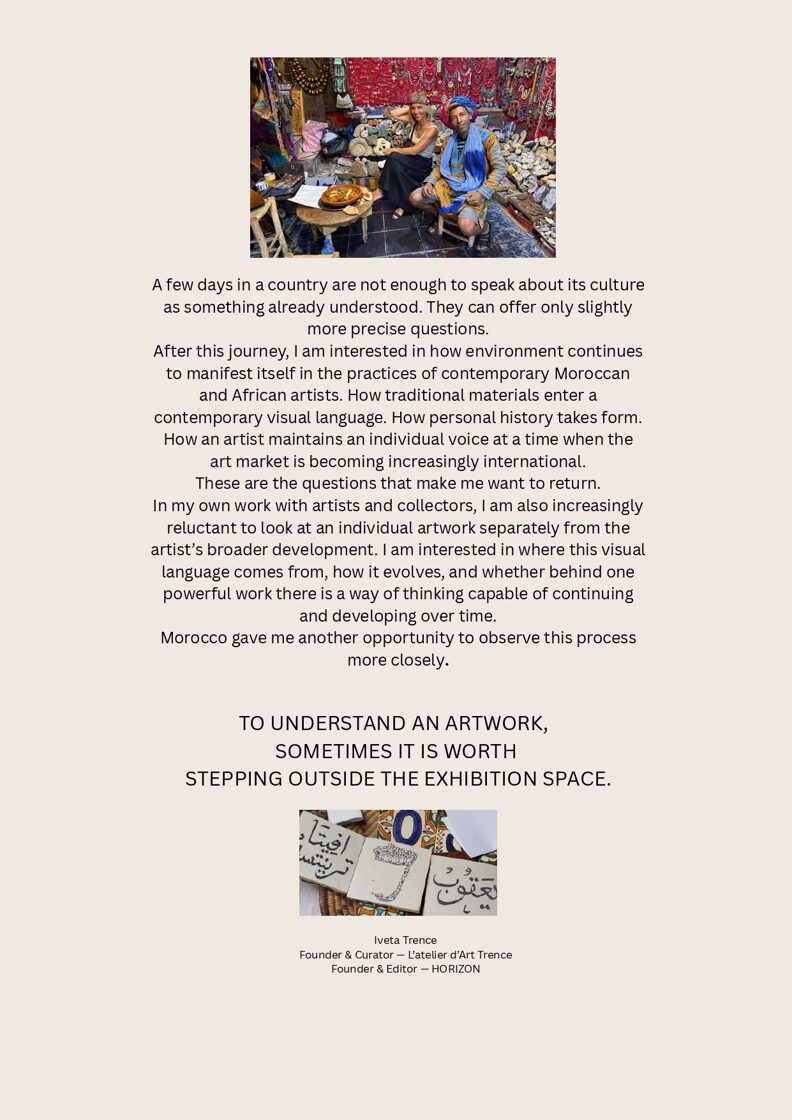
A few days in a country are not enough to speak about its culture as something already understood. They can offer only slightly more precise questions.
After this journey, I am interested in how environment continues to manifest itself in the practices of contemporary Moroccan and African artists. How traditional materials enter a contemporary visual language. How personal history takes form. How an artist maintains an individual voice at a time when the art market is becoming increasingly international.
These are the questions that make me want to return.
In my own work with artists and collectors, I am also increasingly reluctant to look at an individual artwork separately from the artist’s broader development. I am interested in where this visual language comes from, how it evolves, and whether behind one powerful work there is a way of thinking capable of continuing and developing over time.
Morocco gave me another opportunity to observe this process more closely.
TO UNDERSTAND AN ARTWORK, SOMETIMES IT IS WORTH STEPPING OUTSIDE THE EXHIBITION SPACE.
Iveta Trence
Founder & Curator — L’atelier d’Art Trence
Founder & Editor — HORIZON