IVARS GRĪNBERGS
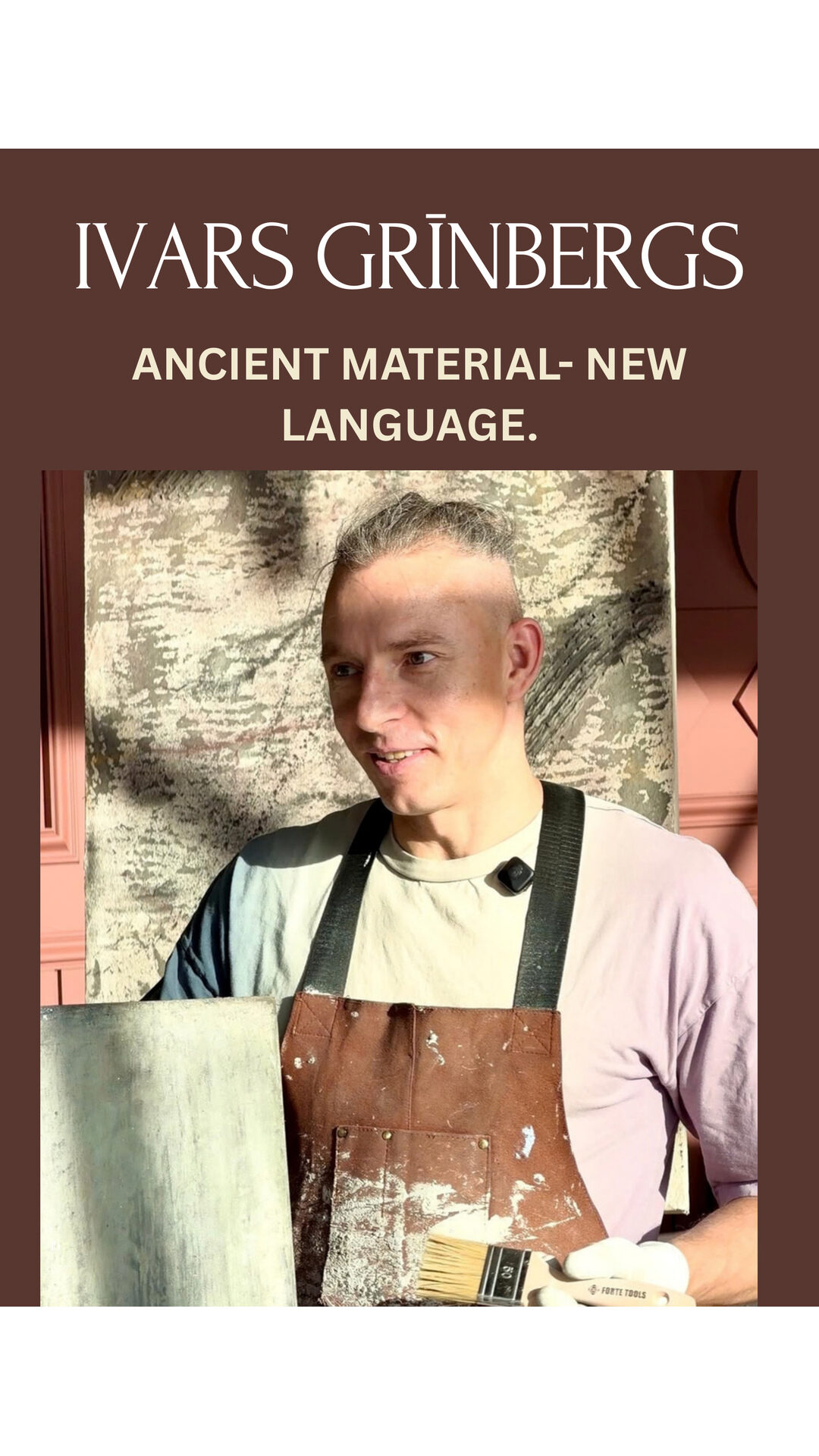
A NEW LIFE FOR AN ANCIENT MATERIAL
Ivars Grīnbergs is an artist whose creative practice centres on lime- one of the oldest materials used by humankind in architecture and the shaping of space. For centuries, it has covered walls, formed surfaces and become part of the life of buildings. Ivars has come to know this material in remarkable depth, and through years of experimentation has discovered within it a potential for contemporary art and design.
Lime has become part of his artistic language.
His relationship with the material has developed over many years. Initially, lime plaster was part of Ivars’ professional everyday life. Working with it over time gave him a kind of knowledge that cannot be gained through theory alone- an understanding of its density, layers, texture, drying process, cracking and response to its surroundings.
Gradually, professional experience developed into artistic research.
Ivars began experimenting with lime beyond its conventional use. He explored how the material behaves on different forms and objects, how it follows a shape, covers it and creates an entirely new surface. He became interested in relief, texture, cracks, layers, light, and the way the same surface changes depending on the space and the viewer’s perspective.
It was through this process that an important discovery emerged.
Lime has the ability to transform the identity of an object.
When applied to a contemporary design object, the material creates a new visual quality. The form remains, while its surface acquires depth, tactility and the individuality of the artist’s hand. The object becomes a unique work, as every layer of lime, every gesture and every natural reaction of the material contributes to a result that cannot be precisely repeated.
Within this process, Ivars has found his own territory between art, design and architecture.
His surfaces carry the ancient history of lime, while their visual language belongs to the present. Clean forms, restrained aesthetics, rich textures and the interaction of light with the surface allow the material to enter contemporary interiors, design objects and spaces for contemporary art.
In Ivars’ work, lime is a living material. It continues to react, develop subtle nuances and preserve traces of the hand that shaped it. The artist does not seek to control its every movement. He knows the material well enough to understand when to guide it and when to allow it to participate in the creation of the work.
Ivars describes this process simply: he trusts his intuition, the material and the process of creation itself.
His research also touches on questions of value. Ivars works with objects that may be damaged or may have lost their original function. Through the application of lime, they can acquire a new identity and continue their existence in another form. This approach is closely connected to his understanding of sustainability — the ability to recognise potential and continuation within a material or object.
One significant work within this ongoing exploration is Between Centuries. Here, Ivars addresses the history of lime and its presence in the contemporary world. A line of light incorporated into the work continues the story of the surface and symbolises the transmission of knowledge, ideas and values from one generation to the next.
Today, Ivars is interested in discovering how far this material can be taken.
His thinking is moving towards larger scales, spatial works, architecture and installation. A lime surface can extend beyond the individual object and become part of a space. It can inhabit a wall, an architectural element or a large-scale installation, creating its own relationship with light, the human presence and the surrounding environment.
Ivars Grīnbergs continues to explore a material he has lived and worked with for years. Through this long process, he has discovered in lime a way to speak the language of contemporary art and design — to shape surfaces, transform objects, define the character of a space and give an ancient material a new presence.
The exploration continues.